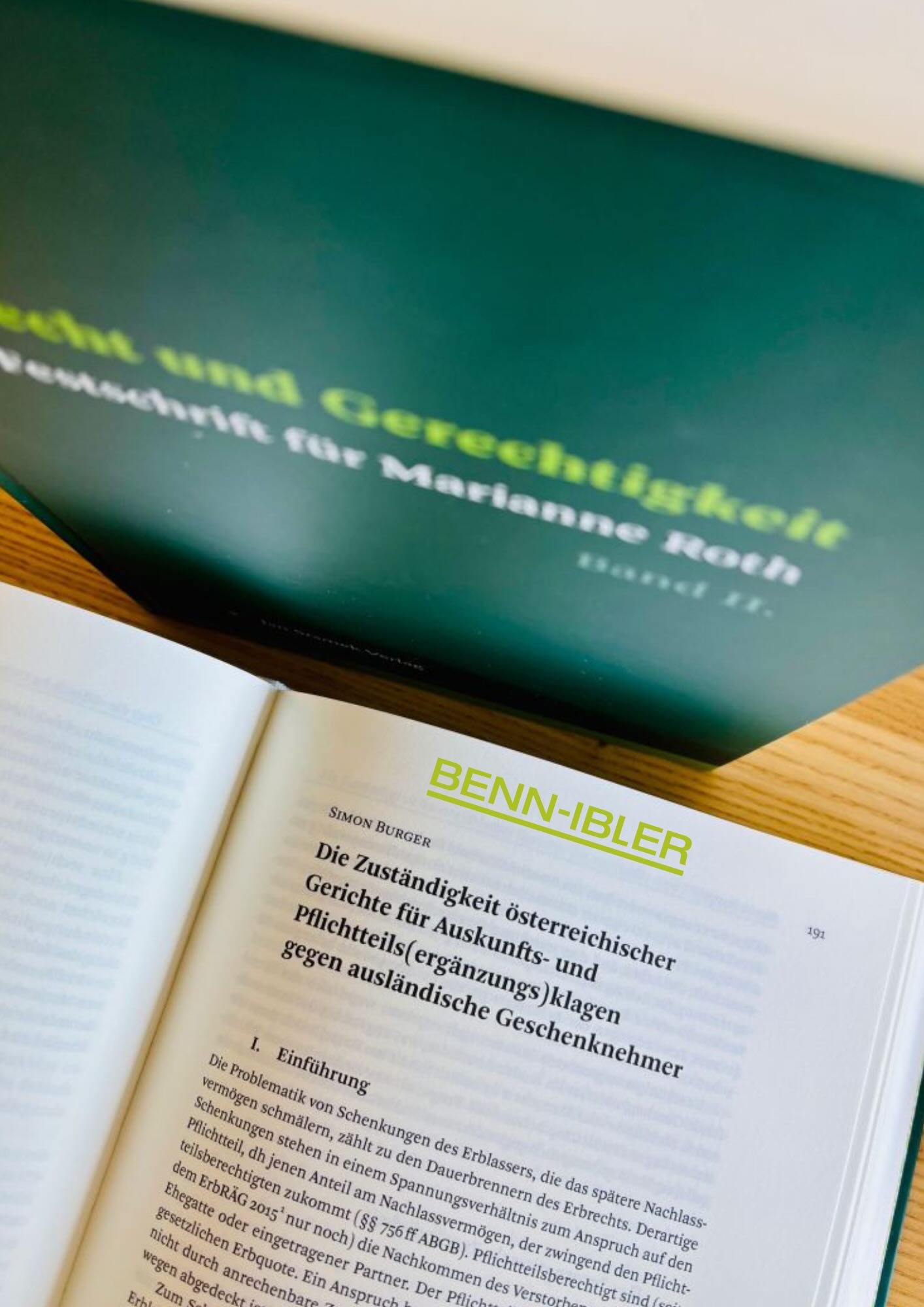
Jurisdiction of Austrian Courts in Actions for Information and Compulsory Portion against Foreign Gift Recipients
Introduction
In recent years, the jurisdiction of Austrian courts over actions for information and supplementary compulsory portions against foreign gift recipients has become increasingly significant. The Austrian inheritance law reform (ErbRÄG 2015) and the clarified right to information (Section 786 ABGB) provide compulsory portion beneficiaries with the opportunity to review gifts made by the testator and claim any shortfall if the estate is insufficient. In the event that the intended recipient of the gift is located outside of Austria, the primary inquiry pertains to the legal jurisdiction in which such claims can be pursued.
Compulsory portion and information rights in Austria
- Compulsory portion beneficiaries: Since 1 January 2017, this group has been limited to descendants, spouses, and registered partners.
- Compulsory portion: One half of the statutory inheritance share, unless creditable benefits apply.
- Gifts: Gifts are added to the estate value; if the estate is insufficient, the gift recipient is proportionally liable for the shortfall.
- Right to information (Section 786 ABGB): Compulsory portion beneficiaries may request information about gifts if they assert and prove that the gifts are, or may be, relevant to their compulsory portion.
International jurisdiction
EU Succession Regulation
- Basic rule (Article 4): Jurisdiction lies with the courts of the Member State where the deceased was habitually resident at the time of death.
- Subsidiary jurisdiction (Article 10): This may apply, for example, if estate assets are located in the Member State or the testator previously had a comparable habitual residence there.
- Exception (Article 11): Emergency jurisdiction may apply where proceedings abroad would be unreasonable or impossible.
- Relevance for supplementary compulsory portion claims: : In Case 2 Nc 32/23p, the Austrian Supreme Court (OGH) accepted that a claim against a foreign-resident gift recipient may be brought in Austria under the EU Succession Regulation, although the gift recipient’s precise legal position remains unclear.
Third-country agreements
- EU Succession Regulation: Bilateral agreements, such as those with former Yugoslav states or Russia, remain unaffected.
- Relevance: These agreements may govern jurisdiction over compulsory portion and information claims; their application must be assessed case by case.
Brussels I Regulation
- Exception: Supplementary compulsory portion claims are generally governed by the EU Succession Regulation and therefore fall outside the Brussels I Regulation.
- Information claims: Their classification as succession matters is unclear, so jurisdiction under the Brussels Regulation remains uncertain.
- Connection rule (Article 8(1)): This principle finds application in instances where claims are closely connected, though this may be uncertain when multiple recipients of gifts are involved.
National jurisdiction
- Section 77(1) of the Austrian Jurisdiction Act (Jurisdiktionsnorm), hereinafter JN) Jurisdiction lies in the district of the probate court until probate proceedings conclude, but only for actions against persons whose legal position derives from succession law.
- General defendant jurisdiction: Jurisdiction depends on the defendant’s domicile or habitual residence (Section 66 JN).
- Assignment of jurisdiction (Section 28 (1)(1) JN): If no general place of jurisdiction exists, an Austrian court may be designated for the action against the foreign defendant.
- Place of jurisdiction (Section 93 (1) JN): Its application to compulsory portion and information claims against several gift recipients is doubtful because there may be no substantive joint action.
Practical guidance for legal practitioners
- Third-country agreements: Determine whether a bilateral agreement governs jurisdiction.
- Jurisdiction assessment: Verify whether the testator was habitually resident in Austria at the time of death and whether the EU Succession Regulation applies.
- Assignment of jurisdiction If the gift recipient has no residence in Austria, an Austrian court may be designated.
- Right to information: The request must demonstrably concern gifts relevant to the compulsory portion, and the supporting evidence is decisive.
- Documentation: carefully archive all relevant documents (proof of donation, list of estates) to prove responsibility.
Conclusion
Information and supplementary compulsory portion claims against foreign gift recipients involve difficult jurisdictional questions. The EU Succession Regulation offers a framework, but it is still uncertain whether such claims qualify as succession matters under the Regulation. At a national level, court designation may provide a practical solution where no general place of jurisdiction is available. Legal practitioners should assess international jurisdiction at the outset, review any relevant bilateral agreements, and maintain strong documentation to support their clients’ position.
This article is for general information purposes only and is not a substitute for advice in individual cases.
